

By February 2026, Alberta’s Major Projects list highlighted an impressive $46.95 billion in new data centre initiatives. If realized, these projects promise to create a significant positive impact on Alberta’s GDP and boost economic growth. The question is, what long-term jobs will the industrial development of data centres create in Alberta?
This article outlines the operational roles expected as data centres are established in Alberta. Our primary data source is the announced data centre projects in Alberta’s Major Project List. By evaluating factors such as labour intensity and variability, automation sensitivity, and demand elasticity, we provide insights into what the workforce could look like if planned data centres are established.
Key Insights
Data centres: Energy projects first, digital projects second.
The proposed wave of large-scale data centre developments in Alberta will require over 5.2 GW of power by 2029—a significant addition to a grid that typically operates within an 8–12 GW demand range. In effect, these projects alone could represent up to ~65% of the current provincial load, reshaping Alberta’s power demand profile. Provincial directives now require data centre developers to “bring their own power.” This means energy infrastructure must be financed, permitted, and operational before a single server is deployed.
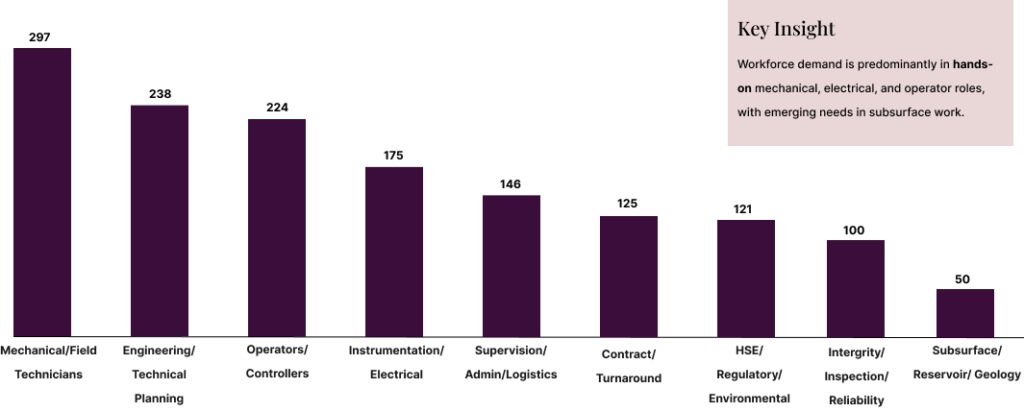
Developers will need to stand up new generation capacity, alongside supporting infrastructure, including natural gas production and processing, power generation facilities, transmission and interconnection upgrades, and fuel supply logistics. This phase will drive substantial job creation across upstream energy, midstream infrastructure, and grid development, as shown in Figure 1.
Alberta’s policy shift—from production caps to carbon competitiveness—creates a pathway to expand energy production while managing emissions at scale. Given the expected reliance on natural gas generation, this implies significant deployment of Carbon Capture, Utilization, and Storage (CCUS) across power and industrial systems. Consequently, CCUS will become increasingly embedded in the energy strategy, driving new demand for specialized roles in capture systems, CO₂ transport, storage, and monitoring, especially for subsurface specialists.
Fig 1: Energy Infrastructure Workforce (FTEs) Required to Support Development of Multiple Data Centres (Combined 5.2 GW Capacity)
What this means:
Mechanical, electrical and operator roles will dominate the energy workforce with emerging demand for subsurface specialists.
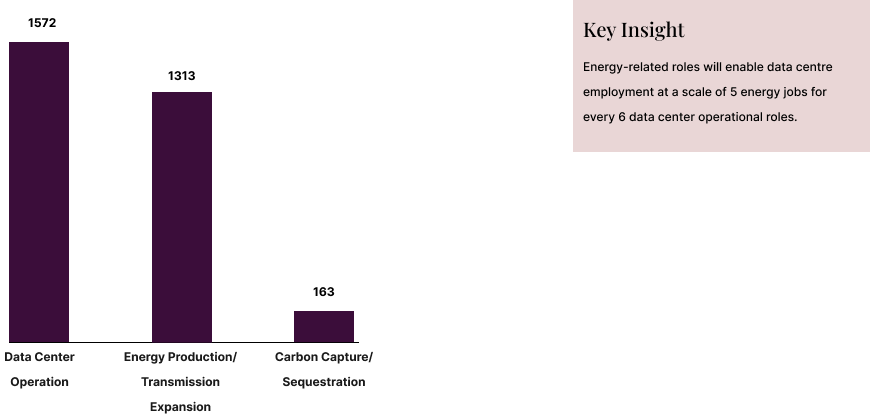
Energy-related roles will precede and enable data centre employment, with a rough order-of-magnitude relationship of ~5 energy jobs for every 6 data centre operational roles, as shown in Figure 2.
Fig 2: Projected Operational FTEs Across Multiple Data Centres (Combined 5.2 GW Capacity) and Associated Energy Sector FTEs
Workforce pressure will be infrastructure-led
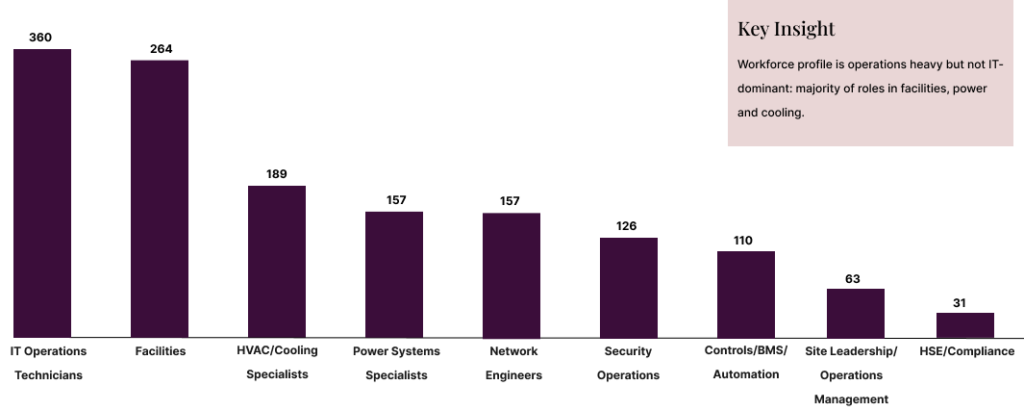
A typical data centre facility employs only a few dozen permanent staff, with roles concentrated less on software and more on operations, infrastructure, and reliability. Using staffing benchmarks and workforce data, the total number of operational roles required is expected to range from 1,048 to 2,359 FTE, with a central estimate of ~1,572. As shown in Fig 3, demand will be concentrated in:
Engineering: electrical, mechanical, and controls;
Facilities and infrastructure operations: electricians, heating, ventilation and air conditioning (HVAC) techs; and
IT operations.
IT roles will remain critical, but not dominant. We estimate they will account for ~30% of total operations roles. Across Meta and Google data centres, the most consistently hired roles are in electrical, mechanical, and facilities systems—confirming that data centres operate as infrastructure systems rather than IT-dominant workplaces.
Within the IT roles, workforce data suggest that demand will be dominated by skilled labourers. In particular, fibre technicians, physical connectivity installers, and network engineering techs.
What this means:
Post-secondary institutions: Shift from IT software-heavy programs to electrical, mechanical and physical connectivity training.
Government: Align workforce strategy with energy and infrastructure development.
Industry: Expect increased competition for trades and facility operators—not software engineers.
Fig 3: Distribution of FTEs Across Core Operational Functions for Multiple Data Centres with a Combined 5.2 GW Capacity.
Operations ramp-up: 2028
Based on our analysis of large-scale project delivery timelines, operational hiring tied to new developments is likely to begin ramping up in 2028. To arrive at this, we examined historical construction timelines on a per-billion-dollar basis and layered in two critical dimensions of risk.
First, realization risk—the likelihood that announced projects actually move forward. This was assessed through pre-construction signals: municipal readiness, strength of demand, regulatory and policy pathways, and access to enabling infrastructure such as power, water, cooling, and labour. Second, construction risk—the variability in delivery timelines once projects are underway. Here, we drew on historical benchmarks, factoring in labour availability and the potential for schedule slippage.
Across both dimensions, projects that clear early-stage hurdles today translate into operational workforce demand within a compressed 2-year window.
What this means:
Alberta is now operating within a narrowing window (2026 to 2028) to align workforce systems with emerging demand. By the time hiring begins at scale, the ability to respond will be largely predetermined by the actions taken now.
In practical terms, the 2028 workforce should already be in development.
Conclusion
In Alberta, the AI economy will be built by electricians, operators, and engineers before it is run by software. We are at the brink of a transformative era that will involve both an energy transition and a workforce transformation as the province adapts to a changing landscape of major investments and technological advancements.
The changes ahead present both challenges and opportunities. To fully harness these opportunities, government, educational institutions, communities and industry must collaborate to ensure a skilled workforce.